
Content first
Detailed medical presentations needed to stay readable, calm and easy to follow from every seat in the room.
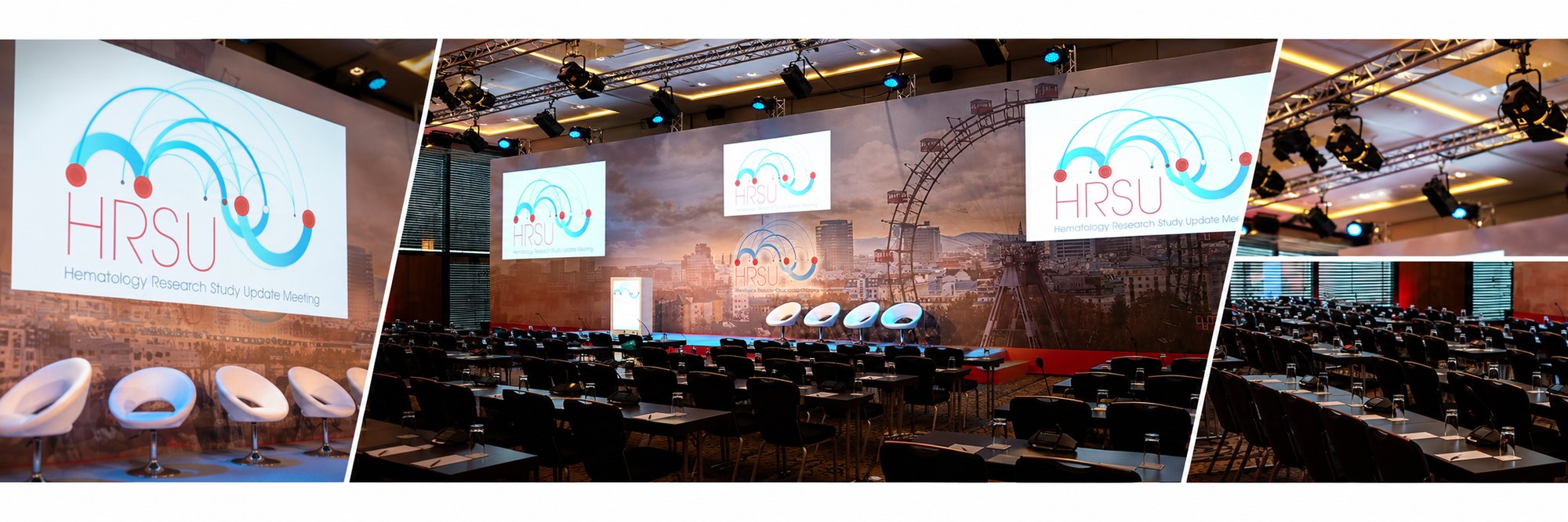
Case study | Technical event production | Vienna
A branded medical meeting built around clarity, consistency and trust. Bano supported Takeda HRSU in Vienna with scenic production, AV, audio, lighting, audience interaction and on site technical direction.
In March 2019, Bano supported the technical production of the Hematology Research Study Update, HRSU, in Vienna, Austria.
The event took place shortly after Takeda completed its acquisition of Shire. That made the meeting more than a scientific update. It was also a moment of transition, where brand identity, stakeholder confidence and international consistency had to come together in one physical event environment.
For 150 international medical experts and stakeholders, the room needed to feel professional, calm and authoritative. The focus had to remain on the content, while the setting clearly reflected the new corporate identity.
Bano translated that challenge into a complete technical and scenic production. The result was a strong branded meeting environment with a large custom stage set, integrated screens, professional audio, discussion technology, lighting, video control, hospitality branding and on site technical direction.
Corporate rebranding is always sensitive. In a medical and pharmaceutical environment, it becomes even more important.
The audience does not come for spectacle. They come for knowledge, clarity, trust and scientific exchange. That means the event design has to support the content first. Presentations, research updates and expert discussions need to be clearly visible, audible and easy to follow.
At the same time, the visual environment needs to support the brand. In Vienna, the room had to reflect a company in transition without creating confusion or visual noise.
Detailed medical presentations needed to stay readable, calm and easy to follow from every seat in the room.
The physical setting had to make the brand transition feel controlled, credible and consistent.
The concept needed the logic of a roadshow: strong enough to recognise, flexible enough to adapt.
This was not about adding more equipment. It was about making the right technical choices early, so the stage, screens, sound, lighting, branding and crew all worked together as one event system.
One of the key elements of the production was a custom stage backdrop measuring 20 metres wide and 5 metres high. The design combined a full colour printed backwall with integrated screens, creating a clear visual anchor in the room.
For international roadshows, this type of approach is valuable because it creates a recognisable brand environment that can be repeated across locations. The exact room may change, but the visual language stays consistent.
Medical meetings rely heavily on presentation quality. Slides often contain research data, charts, tables and detailed speaker content. If the image quality is poor, the audience experience immediately suffers.
For this production, Barco RLM-W12 projectors were used, controlled through a Barco S3-4K processor. This created a reliable video setup for sharp presentation output across the main screens.
The event included 75 Dicentis discussion units, allowing the audience to participate in a structured and professional way.
For a medical expert meeting, interaction is not a side feature. It is part of the value of the event. Questions, comments and expert dialogue need to be easy to manage and easy to hear.
A Meyer Sound system was deployed, including MINA line arrays. The goal was clear and controlled sound coverage for a professional conference environment.
Audio is often invisible when it works well. But in a medical or scientific setting, it is one of the most important parts of the production. If speech is unclear, the audience misses information.
The lighting design included Clay Paky B-Eye K10 Easy fixtures, used to support both the symposium setting and the evening programme.
For a corporate medical event, lighting has to be balanced carefully. The room should not feel flat or purely functional, but it should also not feel theatrical in a way that distracts from the content.
The production also included custom LCD lecterns and branded hospitality desks in the lobby.
A strong event identity does not begin when the first speaker walks on stage. It starts when guests arrive. Registration, hospitality, wayfinding and lobby communication all influence how attendees experience the brand.
International roadshows are not won by equipment lists. They are won by a technical concept that feels consistent, calm and reliable in every room.
Bano managed the technical trajectory from site visits in Vienna to final on site delivery. This included coordination with external partners, including SpotMe for the event app.
For international roadshows and corporate meetings, this single point of technical coordination is one of the biggest risk reducers.
Event agencies and corporate organisers often work with many moving parts: venue teams, app providers, local crew, AV suppliers, scenic builders, interpreters, transport partners and content teams. Without central coordination, responsibility becomes fragmented.
A technical producer connects these parts. They understand the creative goal, the technical requirements, the venue limitations and the pressure of the live moment.
The Takeda HRSU case demonstrates principles that are useful for agencies and corporate teams planning international events, medical meetings and cross border roadshows.
A repeatable roadshow format starts with a modular scenic and technical concept. It should be strong enough to feel premium, but practical enough to adapt to different venues.
During a rebrand or integration phase, visual consistency helps create confidence. The brand should be clearly present without taking attention away from the content.
Expert audiences need structured and professional ways to participate. A good discussion setup makes dialogue feel natural, controlled and valuable.
One technical lead creates clarity between the client, agency, venue and suppliers. That is especially important when an event crosses borders.
International events are judged on details. The audience may not know which projector, processor, microphone system or line array is being used. But they do notice whether the room feels professional, whether the content is clear, whether speakers are comfortable and whether the brand experience feels consistent.
That is why technical production should be involved early in the process. Not only to check what is possible, but to help shape the event into a format that works in real venues, with real people, under real time pressure.
For roadshows, medical meetings and corporate stakeholder events, the technical concept is not just a support layer. It is part of the trust you build with the audience.
Bano supported the technical production of the Hematology Research Study Update in Vienna. This included scenic production, video, audio, lighting, discussion technology, branded elements, supplier coordination and on site technical direction.
The event combined a high level medical programme with a sensitive corporate brand transition. The technical setup had to support detailed scientific content, expert interaction and a consistent branded environment for an international audience.
The production used a modular stage concept, professional video processing, structured audience interaction, high quality audio and central technical coordination. These elements are essential when a corporate event format needs to be repeated across multiple cities or countries.
Visual consistency helps audiences recognise and trust the brand. It also gives corporate teams and agencies a clear format that can be adapted to different venues without losing the core identity of the event.
A technical producer can translate creative and strategic goals into a setup that works in real venues. This helps prevent problems with sightlines, audio coverage, screen visibility, build time, supplier coordination and live event flow.
Bano supports agencies and corporate teams with technical event production, AV, staging, lighting, sound, video and on site direction across the Netherlands and Europe.